


In the early 1900s John D. Rockefeller wrote a series of 38 letters to his only son, teaching him everything that he knew.
Not just about oil, or business, but about how to have principles so strong that wealth is inevitable.
Now in case you don’t know much about Rockefeller, here’s a quick refresher.
Rockefeller founded a company called Standard Oil, which processed and transported oil across the United States.
His company quickly took over the oil market, making him the richest man in American history with an estimated net worth of 1.4 billion dollars
That’s around 400 billion in todays dollars.
At his peak, his wealth made up nearly 3% of the entire US economy. (Uncover lens)
But what’s interesting about Rockefeller isn’t just what he built, it’s how he thought about passing it on. These letters weren’t written to the public, they we’re written to his only son, and in these letters he gives his son a blueprint for how to build wealth.
And what stands out in these letters isn’t just the advice, it’s how different it is from what most of us were ever taught. Because Rockefeller knew that wealth isn’t passed down in currency, but it’s passed down in knowledge, and that’s exactly what these letters show.
So I broke down these letters into three categories and 15 principles that define how Rockefeller made his fortune.
If you continue to read I will take you through the principles John D Rockefeller believed would shape a son more wealth than ever.
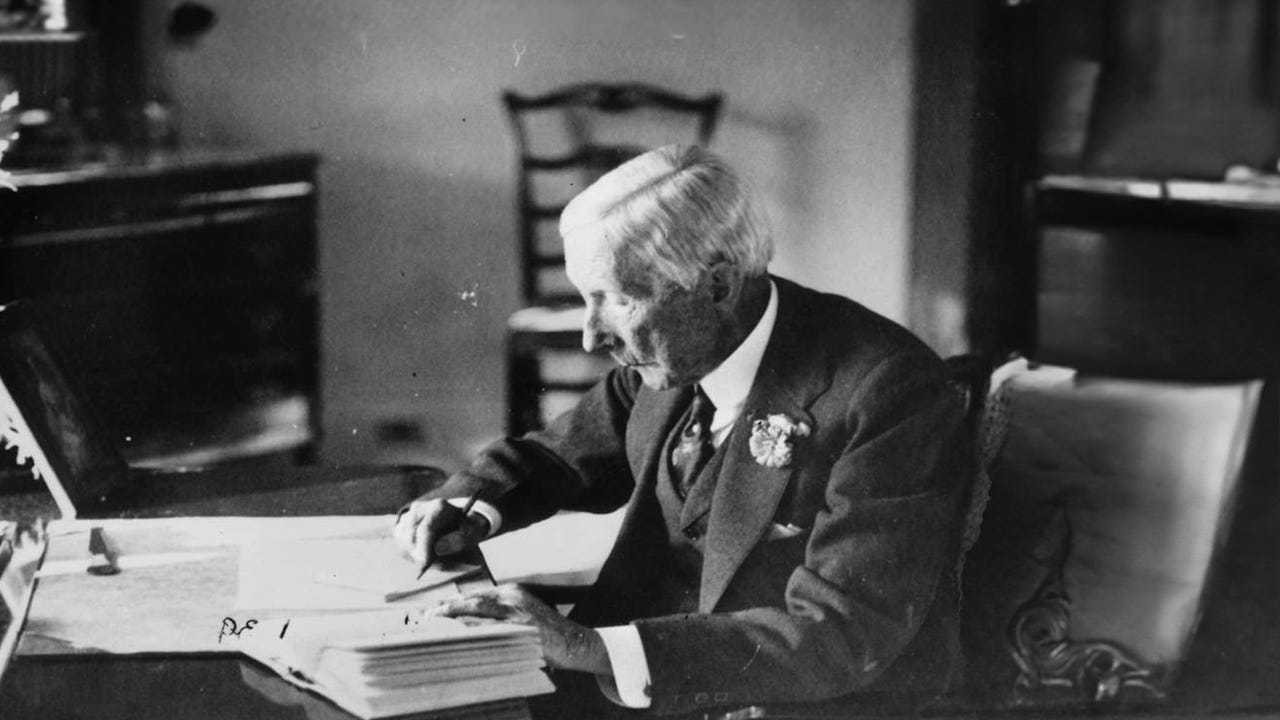
Part 1: Mind- How He Trained His Son’s Thinking
Hardship Builds Character
“So where does the ability to practice come from? In my opinion, it is hidden in hardship. My experience tells me that walking a difficult road—a road full of hardships, misfortunes, failures and difficulties—will not only build our strong character, but also the ability to implement great things. Those who climb out of the midst of suffering know what it means to find ways and means to save themselves. To endure hardship deliberately is one of my beliefs of success.”
This quote encapsulates Rockefellers belief on hardship. He believed that hardship builds character and makes you resilient. This is of course based on his own experience. When he was young his family was very poor.
One time when he was a kid, he was all excited to go to school because there was going to be a photographer there. And photographs back then were very expensive so it was a rare occasion. But when the photographer was going to take the picture, he asked John to get out of the frame as his clothes were too shabby as compared to his classmates.
Rockefeller remembered this moment for decades saying about it:
“Looking at the adjusted camera scene, I clenched my fists in my heart and swore to myself: One day you will become the richest person in the world! What is the point of having a photographer take a picture of you!”
And Rockefeller faced a lot of this growing up.
His books in high school were all bought by neighbors, he started his career as a bookkeeper with a weekly salary of 5 dollars, from the very beginning he faced obstacle after obstacle and according to him, this is what built his character.
He said:
“ I believe that there is not one person in the world that does not long for a happy and luxurious life, yet not many people know where it comes from. In my opinion it does not come from wealthy blood , nor from a luxurious lifestyle, but from a luxurious character- the spirit of self reliance.”
He even went so far as to hide the fact that he was rich when his kids were growing up because he knew:
“the quickest way to harm someone is to give them money”.
So if you’re currently going through some hardship, know that it’s not for nothing. The hardship that you’re currently facing is building your character, and that will build ultimate wealth in the future.
2. Fail, A Lot
At one point in his Rockefellers life, he was just entering the job market and looking for a job and he writes about how he would get up at 8am every day, get dressed and look for a job, but for several weeks it was rejection after rejection, but he told himself :
“You are the only one who can go on forever. I warned myself: if you do not want others to steal your dreams, then you stand up immediately after being knocked down by setbacks”
Six weeks later he landed a job at the Hewitt-Tuttle Company and 3 years later he left that job and co-founded what would become Standard Oil. But it all started the day he got the job which he apparently celebrated every year as his “rebirth day”
The reason this day was important to him though, is because of the amount of failures he overcame, he said:
“My motto is: People always have to maintain their energy, remain strong and persistant, no matter what failures and setbacks they encounter, this is the only thing I can do.”
He even brought up Thomas Edison saying that Edison conducted 10,000 experiments before making the light bulb, and that to him failure was a test field for success. Every single time that Edison failed with the lightbulb he was one step closer to success.
Rockefellers formula was simple .
It was Dream + Failure + Challenge = Success
And when studying greatest people in history, a lot of them we’re also the greatest failures.
The Wright Brothers had over 700 test flights before they finally had a successful flight.
Nikola Tesla filed over 300 patents most of which failed commercially.
James Dyson built 5,126 prototypes over 15 years of the Dyson vacuum cleaner before his 5,127th design finally worked and launched a billion dollar company.
There is no short cut.
Sometimes the best way to move forward is to simply fail a lot.
3. Love To Work
“I think that work is a privilege, as it brings more than just sustaining life. Work is the foundation of all business, the source of prosperity, and the shaper of genius. Work makes young people work harder and do more than parents no matter how rich they are. Work is expressed in the humblest form and lays the foundation for happiness. A job helps add flavours to life. But people must love work before it can return the biggest favours and achieve the greatest results.”
Rockefeller loved to work. It’s as simple as that. And although there’s a lot of reasons to not like work, there’s an analogy that might help understand this a bit better.
3 people are busy at work doing the same sculpting job.
You go to the first one and ask what are you doing. And he says :
“I am chiseling this stone so that I can then go home.”
This kind of person see’s work as a punishment.
The second one says:
“I am making a statue. This is a very hard job, but the compensation is high and I have to feed my family”
This kind of person although better than the first, is still not likely to build much wealth throughout his life.
And then there’s a third who points proudly at his work and says :
“I am making a piece of art”.
This kind of person takes pride in and enjoys his work, and what he finds is meaning.
Rockefeller writes to his son:
“John, if you view work as a pleasure, life is heaven; if you view work as a duty, life is hell. Reflect on your work attitude, it will make everyone happy”
4. Don’t Worship Money
One interesting thing about Rockefeller was that he was a devout Christian, but he was always clashing with many of the christians from that time because of their different philosophies. One of the big clashes he got in was of course about money.
There’s a verse in the Bible in the book of Timothy that says:
“the love of money is the root of all evil”
For Rockefeller he believed that loving money is only bad as a means of worship and not as a motive. Rockefeller actually saw being rich as a good thing.
He said:
“If you have money, you can benefit your family and friends, and give them a happy and comfortable life, and even benefiting the society, save the helpless poor people, then money will become the source of happiness”
To Rockefeller, money was like fire. Dangerous if you worship it, as you would probably become an arsonist, but if it’s in the right hand, you can use it to cook food, keep you warm, and light up the dark. Fire itself isn’t bad but when looked at in the wrong way it can become bad.
He even went so far as to say:
“I firmly believe that God has clear rewards and punishments, and that my money is given by God. And I can always make money. If God helps, this is because Go knows that I will return the money to society for the benefit of my fellow citizens.”
Not to mention that he finishes this letter with:
“It is time for me to read the Bible. The night is so beautiful tonight, every bright start seems to say ‘Good job! John’ Love, Your Father”
5. No Excuses Ever
“In my opinion “excuses” is a mental illness, and the people with this serious illness are all losers without exception. Of course, most people also have some mild symptoms. However, the more successful a person is, he less excuses he will find. The biggest difference between those who are prospering everywhere and those who do nothing is excuses.”
According to Rockefeller the worst type of excuses are health, intelligence, and luck.
The first of which being health in which people will say “I have this illness or this physical problem” Yet there’s the old saying that goes “I have been annoyed by my broken shoes until I met a man who has no feet”.
To give an example probably the most famous historical British person aside from Winston Churchill was a naval captain named Horatio Nelson.
At age 36 he lost sight in his right eye at the battle of Calvi, Corsica.
Two years later he lost his arm at the battle of Santa Cruz de Tenerife.
Yet even after this he continued his naval command and marked his name in history by defeating Napoleons Nay at the battle of trafalgar.
There are always excuses, but Rockefeller’s point is to just keep moving forward.
The second is intelligence and a lot of people fall into this one due to schooling. It’s a well known fact that IQ is highly correlated to the amount of money you will make in the future. However one thing that’s almost never measured is enthusiasm. Someone with a high IQ who is enthusiastic will always beat someone who is pessimistic, and since IQ isn’t something you can control you might as well focus on enthusiasm.
And the third is luck. Most of the times when you really investigate luck you will find that behind people who are “lucky” you will find preparation planning, and positive thinking.
“Excuses keep most people out of the door to success. Ninety-nine percent of failures are because people are used to making excuses”
6. Be Optimistic
“the level of confidence determines the level of achievement”.
This one is huge for Rockefeller, but it’s also huge for people like Walt Disney, Napoleon, and Peter Thiel. They’re all relentless optimists.
“successful people are just ordinary people who believe in themselves and affirm what they do. Never, never sell yourself cheaply”
In the end this is always what success comes down to. It’s believing in yourself, plus affirming that belief with your actions.
When Rockefeller was entering the oil business many people thought it was reckless. At that point in history the oil sector wasn’t as big as it is now, and it was a risky gamble, but Rockefeller jumped fully into the oil world. It was an optimistic belief followed by his actions showing his belief. And at the end of the day that’s all it took.
Now that we covered some of what made Rockefellers mindset, literally unbeatable, let’s go over the tactics he used to actually be unbeatable. Because his mindset was only part of the picture. The rest of it was straight warfare.
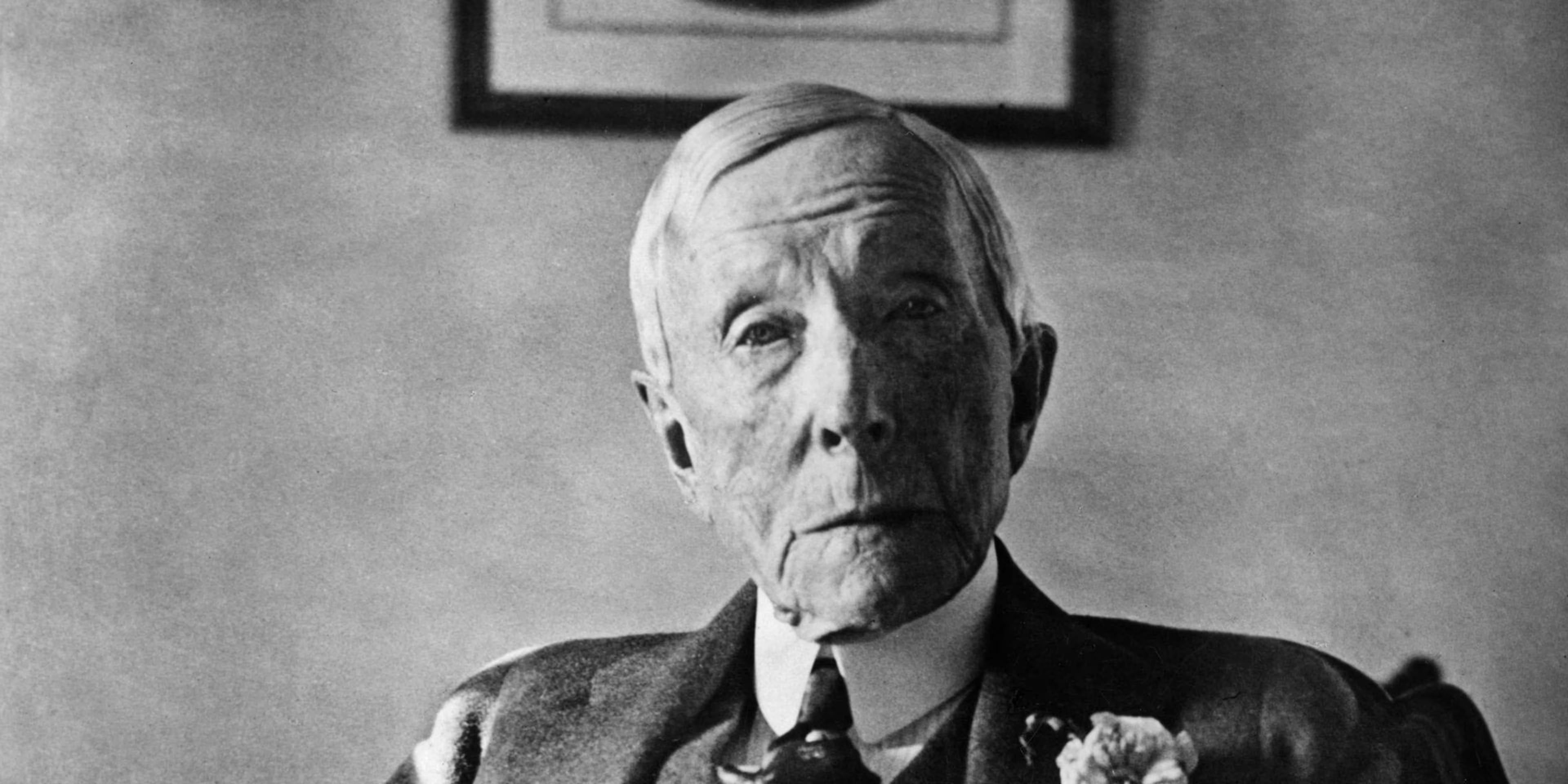
Part 2: War- How To Compete In The Business World
7. Business is war
The first thing you have to understand is that Rockefeller saw business as a war, and he was ruthless. He didn’t just set out for a slice of the pie but he set out for the entire pie, and anyone who tried to stop him was an enemy.
At one point one of his competitors named Benson wanted to build a 110 mile pipeline connecting Pennsylvania to the west. This pipeline would very much hurt Rockefellers business so he wasn’t about to let that happen. So first he tried buying the land the pipeline would go through, but Benson simply took a detour approach and kept going. He then told all of his allies to never let any pipelines cross their railways, but Benson did the same and eventually broke through. Eventually the pipeline was completed, but Rockefeller wasn’t done. He said
“I know that I have a tough enemy to conquer, but he cannot shake my determination to compete, because the 110 mile pipeline is my biggest threat. If I let crude oil flow there unimpeded, they will also acquire the supply line to New York. Then, Benson will replace me as the new owner of the New York oil refining industry, concurrently I will also lose ownership over the Bradford oil field. This is something I cannot allow.”
And what he did was kind of genius.
As Benson was enjoying his success Rockefeller sent huge amount of orders to the storage tank producers. Way more than they could handle, and way over their capacity. As the manufacturers got backlogged on Rockefellers order, Benson was unable to transport oil due to not having anything to transport it in. So all the crude oil he was transporting through the pipeline just had to be dumped into the wilderness.
In less than a year Benson surrendered.
“An excellent commander will not attack a bunker that has nothing to do with him but will try to destroy the bunker that is strong enough to destroy the city”.
Rockefeller focused everything on his biggest enemy and won.
It’s also interesting because Rockefeller had a lot of respect for a lot of people throughout his life and Benson was actually one of them. He didn’t hate his enemy but he simply understood that business is war, and focusing all of your efforts towards eliminating your biggest competitor will ensure that you maintain the monopoly.
8. Strong Negotiation
When it came to negotiating Rockefeller a list of 5 things that you absolutely must know in order to have a successful negotiation.
“First, the overall environment: what is the market situation an what is the business situation.”
This is extremely important because in order to have the upper hand you need to have extreme knowledge in the market you’re negotiating in.
For example if your in oil you need to know the process of refining oil, you need to know the real time valuations, you have to be on top of current events and the scarcity of it around the world. All of these facts will influence the negotiation.
“Second, your resources: what are your strengths and weaknesses, and what capital do you have”
“Third, the opponent’s resources: what are the opponent’s assets, and where are his strengths and weaknesses”
You have to play to your own strengths and to your enemies weaknesses.
Like in the story with Benson, Rockefeller clearly had more capital than him, but Benson still managed to build the pipeline. It was only when Rockefeller started exploiting his weakness by targeting the containment manufacturers that he was able to win the battle.
“Fourth, your goal and attitude: The motto of the god of sun Apollo, is only a short sentence: ‘You know yourself’. You need to know what you are doing, what goals you have, and how determined you are to achieve them.”
This one is very simple to remember but extremely hard to apply. How often do you fight a battle that doesn’t need to be fought. Rockefeller didn’t always go all in, but when he did he went all in with both feet. If your opponent is more determined than you than with enough him he will find a way to win, so you have to make sure that you are extremely determined to win.
“Fifth, the opponent’s goals and attitudes: try to judge the opponent’s goals, and it is also important to try to penetrate the opponents heart and understand his thoughts and feelings.”
Humans don’t always act logically. If you can get at the emotion of your opponent, many times you can exploit it and win. This is true in debating, or in sports, or in really any endeavor where you have opponents.
At one point Rockefeller really needed to raise 50,000 dollars and he was desperate to get it. And so he was out the street thinking when a banker came up to him and asked him to spend 50 grand. At that point Rockefeller saw his eagerness and even though he wanted to accept, he asked the banker to give him 24 hours. The next day he signed the loan contract and got very favorable terms He played stupid, he knew what he needed, he knew what the banker wanted, and because of this he was able to get a good deal.
9. Look for investments
In one of the letter’s he wrote to his son he mentions a speech given by a Mr. Charles about the three types of people with money:
“There are two kinds of people in the world that will never be rich:
First people who like to live a glamorous life, like flies starting at a stinky meat. They are very interested in luxury goods. They spend so much that they do their best to have exquisite costumes, expensive cars, luxurious houses, and highly sought after art. This kind of life is indeed fascinating, but it lacks rationality.”
You can think of these types of people like the business owner who instead of being at the office is constantly on vacation, or on their private planes, or wearing crazy clothes. Now he’s not saying that these things are inherently bad, but he’s pointing out that although these experiences are fascinating, they lack real purpose, and that’s the purpose of providing as much value as you can to as many people as you can.
“The second type of people are those who like to save money, and store it in the bank, but it is no different from freezing money. You must know that you cannot make money on interest.”
This is where most people lie. Although instead of bank nowadays, many times it’s a mortgage, or a car loan, or the worst one a credit card.
“However there is a kind of people who will become rich. For example, everyone here. We do not look for ways to spend money but we look for ways to cultivate and manage various investments, because we know that wealth can be used to invest and create more wealth, But we also know that every penny can bring benefits.”
This is where Rockefeller’s secret really lies.
Rockefeller knew that in order to take over the market he had to reinvest his earnings back into the business, and that’s exactly what he did multiple times. There are so many examples in these letters where Rockefeller wants to expand but the people around him want to save money so Rockefeller ends up putting his own money on the line.
He did this because he knew the importance of making every penny work for him.
10. Discover others weaknesses
Rockefeller was known for striking at weakness. One of the clearest examples of this was during the South Improvement Company scheme. While most oil refiners were fighting each other for market share, Rockefeller spotted something they didn’t.
They were all paying full price to ship their oil.
He saw the weakness, and he moved.
He secretly made deals with the railroads. Not just to get cheaper rates for himself, but to collect rebates on every barrel his competitors shipped. That meant every time they moved oil, he got paid. And they didn’t even know it. That single move let him undercut their prices, expand his control, and quietly choke out anyone in his way.
Rockefeller once wrote to his son:
“In a competition, the person who first discovers the opponent’s weakness and strikes hard is often the winner.”
The core idea behind this tactical brilliance is something called a pressure point. In the human body, a pressure point is a tiny spot where a single hit can end the whole fight.
The body is full of these pressure points.
So is business.
A pressure point in a market might be distribution, or information, or timing. The point is that Rockefeller was always searching for these pressure points, and he always made sure to strike there first, should he be given the opportunity.
11. Treat Employees Well
Rockefeller completely dominated multiple markets. But inside his companies he dominated a bit differently. He dominated with respect.
In one of the letters he writes:
“I love my employees. I never scold or insult them loudly, nor do I become domineering and indomitable in front of them like some rich folks do. What I provide my employees is warmth, equality, and tolerance. All these combined into one word is called respect. Give the people the respect they deserve, and they can fully realize their potential.”
This is the part of Rockefeller that most people miss. Because he wasn’t just a business strategist, but he was also a leader of people. He led an entire company to become one of the greatest monopolies in history
So how did he do this?
Well he didn’t believe in being extremely harsh on his workers. Instead, he did his best to draw out the best in them using respect.
You can think of it like in a greenhouse. Inside a greenhouse, the environment is completely controlled. Every factor is meant to encourage the plants to grow as large as possible. This is exactly what Rockefeller built. He created a company filled with systems for people to rise up.
He never raised his voice.
He didn’t try to push others down.
He observed constantly.
And he listened.
To give an example, one of his key employees, Henry Flagler, started as a partner in a small refining deal. Under Rockefeller’s leadership, he grew into the right hand of Standard Oil. Henry was trusted with massive decisions and given the space to execute. This all happened because of Rockefeller’s design though
Rockefeller specifically designed his companies to make sure that his workers could keep rising if they worked hard. The rule was: if you bring results, you will move higher up at Standard Oil. Many of the competitors he bought out eventually became some of his biggest allies at his own company.
On a more personal level Rockefeller believed in a slow trust. Trust that you can earn. Charlie Munger used to say that “Trust is one of the greatest economic forces on earth.” And so Rockefeller looked to work with people who he could depend on, and completely 100% trust.
This structure made Standard Oil thrive.
12. Use Greed
Rockefeller didn’t shy away from greed.
He used it as energy.
He wrote to his son:
“Destiny must be created by oneself… and what one really wants must be obtained by every means.”
That was not some sort of warning, he was telling his son to use greed. He believed greed wasn’t a sort of sin. But instead it was a calling, that there is still more to get, more to do, more places to go and conquer.
Most people treat greed like a fire to be put out. Rockefeller treated it like heat to be directed.
He said:
“Every step I move forward can make me feel the power of greed.”
He continues to say:
“What one really wants must be obtained by every means,”
Remember that he is writing to his son.
This power of greed made him dangerous. It made him incredibly focused. He didn’t crave money for comfort, but he craved it to satisfy an endless hunger.
For Rockefeller greed was a motivation. Greed was focus. Greed was the thing that allowed him to zone in on a task and get it done.
So this may be slightly machiavellian. Or maybe a lot machiavellian. But if you want to use this Rockefeller principle:
Use greed as fuel.
Alright now that we’ve covered Rockefeller’s unstoppable mindset, along with his ruthless business philosophy we have to go over the other part that made him great. Because at some point, the empire becomes a monopoly. At that point the question becomes, how do you leave behind a legacy that lasts, and Rockefeller mastered this art. So let’s talk about that. Let’s talk about how he was able to leave behind a remarkable legacy.
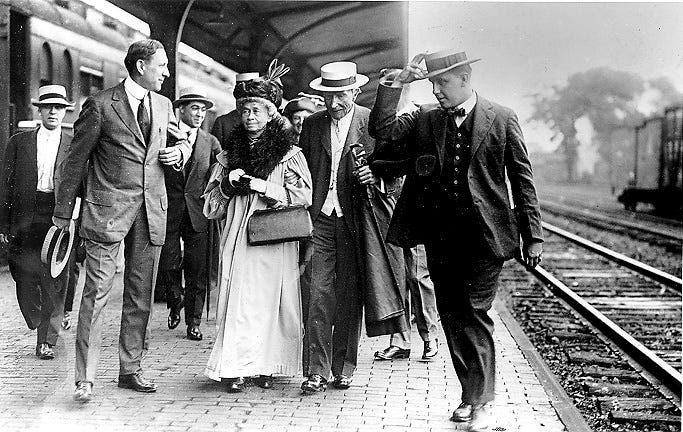
Part 3: Legacy- How To Build Something That Lasts
13. Lead By Example or Take responsibility
There’s this one story that Rockefeller tells his son where he was debating with his board on wether they should buy another oil field in Lima. It was a lot of debating and the board eventually decided that the investment would be too risky. But Rockefeller still had one more move up his sleeve, he told the board
“I decided to use my own money to make this investment and take the risk for two years. If it succeeds in two years, the company can return the money to me ; if it fails, I will bear all the losses myself”
And if you think Rockefeller made the wrong move look at what happens next.
“My determination and sincerity touched my biggest opponent, Mr. Pratt, as tears welled up in his eyes and excitedly said to me ‘John my heart is captured by you. Since you think we should do this let’s do it together! If you can take the risk so can I!”
In the end they succeeded with the Lima fields and made all their money back, but the real lesson here is that true leaders lead by example.
True leaders take responsibility for any outcome that may happen, and they always align their actions with what they profess.
14. Have A Vision
“My son, destiny must be created by oneself, and what one really wants must be obtained by every means. Every night before going to bed I advised myself: I want to become the largest oil refiner in Cleveland, let the flowing oil creek turn into bundles of banknotes, I want to align every thought to profit motives and help myself become the king of oil”
One thing that all great people have is a vision.
There are so many people who are directionless in todays world, so many people unsure of what to do, almost to the point where when someone comes along and says “I have a vision, I have direction” it’s attractive and it’s charming, people actually want to follow you.
Rockefeller knew this to his very core, and he uses this analogy to describe it:
“It is like loosening a yacht from the dock and forgetting to start the motor. You will follow the currents, and sea breeze, currents or other ships that might collied into you and cause you to sink to the bottom of the sea at anytime. Maybe something good is waiting for you on the other side, but unless a miracle occurs, you will not be able to reach the other side smoothly. Establishing a purpose is like turning on the engine of a yacht, which can propel you towards the path you choose. Purpose can add direction and strength to human efforts”
15. Reputation Is Everything
“A person is great not because he has a certain official title. The reason why he is great is that he used a few tools to create a greater cause and accomplish his life goal as an unknown civilian. This is the real greatness.”
At the end of the day Rockefeller was ruthless competitor, a ruthless businessman, and a ruthless negotiator, but all of this can’t be separated from all the good that he did.
Because the same man who crushed competitors also built the University of Chicago.
The same man who squeezed every drop of profit from his pipelines also funded medical research, libraries, and schools all over the world.
Throughout his entire life Rockefeller gave away over 500 million dollars, not just to be charitable, but because he believed that reputation was everything.
From the way that he treated his workers to the countless donations that he contributed to society Rockefeller made sure that his reputation was a good one. And it’s weird because when you think of Rockefeller now, you sort of think of this ruthless business man type, when in reality he actually cared very much about his legacy.
So I would like to end with this quote directly from him:
“If you forget what I said tonight, please do not forget the following statement: The person who thinks the most, feels the noblest, acts the most righteous, and lives the most fulfilling life”
If you liked this article, consider giving me a follow.
I read a biography every week and then write an article about it.
Wishing you all the best in your journey,
-Nic Munoz
"The 38 Letters from J.D. Rockefeller to His Son" is a wildly popular self-help and business advice book in China, though experts note that the letters themselves are widely considered a modern fabrication not actually written by John D. Rockefeller.
Published in China. Not actually written by John D Rockefeller
Hi i found your Substack by your YouTube videos, great content 👍🏻