

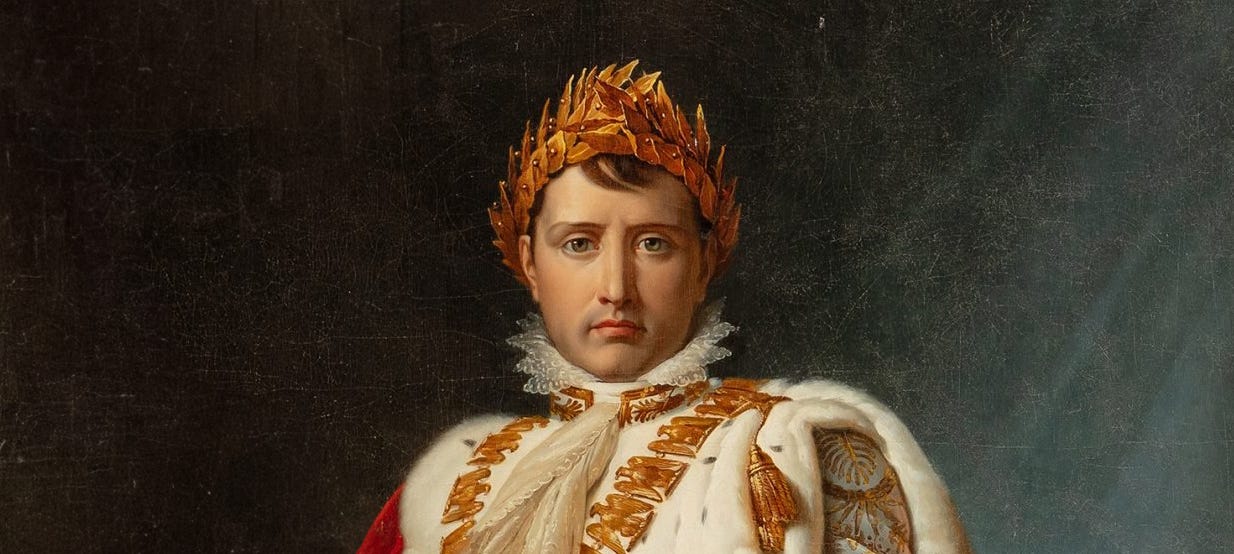
Napoleon did more before the age of 35 than almost anyone has ever done in a lifetime
He was making battlefield decisions at 3 in the morning
Constantly running on almost no sleep
Continually outworking everyone around him
But how was he able to do this?
Well, Napoleon specifically designed his life to maximize things like speed, clarity, and control, and thanks to a 1000 page biography by Andrew Robertson I have a pretty good idea on the habits he used to make this possible.
This book is filled with letters Napoleon wrote, his military maxims, accounts from people closest to him, and detailed accounts of his campaigns. So after reading it I’ve condensed this book down to 13 habits that define Napoleon.
And it all starts with his daily habits.
Compartmentalization
Andrew Roberts explained it best when he said:
“Napoleon was capable of compartmentalizing his life, so that one set of concerns never spilled over into another”
He could go from planning a military invasion to writing legal documents in the same hour without losing focus. Compartmentalization is one of the skills that allowed Napoleon to do so much in his life because it allowed him to switch from task to task without losing any momentum and without carrying any baggage from the previous task.
Here’s how Napoleon thought of it:
“Different subjects and different affairs are arranged in my head as in a cupboard. When I wish to interrupt one train of thought, I shut that drawer and open another. Do I wish to sleep? I simply close all the drawers and there I am-asleep”
You can think of your mind like a cupboard. And every drawer is a different different section of your life. Let’s say you just had an argument with your wife and now you’re struggling to focus on your work. Using the cup bard method, you would simply close the drawer with your relationship while at work and open the drawer for your work. I will say that this is less of a method and more of a lifestyle. The more that you practice this, the easier it will be to shut and open drawers, and the faster that you’ll be able to move from task to task.
During the Italian campaign in 1796, Napoleon had already racked up five major victories, but things were falling apart in the background. France was short on supplies. His generals were worn down, and back in Paris Josephine was cheating on him.
That same week, he sat down and wrote a plan for seven more victories, he wrote to suppliers for more ammunition, he wrote to his generals abut footwear for soldiers, and then he went out an executed his plan.
That’s compartmentalization. He didn’t let other areas of his life bleed into his focus on the campaign. He treated each problem like a new drawer, and only kept one drawer open at a time.
This is a big difference between Napoleon and everyone else. Whenever a problem arose, Napoleon shut out all the other drawers and focused on one single problem. Every other drawer was closed.
2. Strategic Rest
One of the craziest things I found in the Andrew Roberts biography was Napoleons sleep schedule.
During peacetime he got 6 to 7 hours a night. But during war it usually dropped to 3 or 4. Sometimes less, and not all at the same time. This wasn’t because he was trying to prove something, but because he adjusted his rest depending on what the moment required. He’d grab short naps between battles which allowed him to be giving orders constantly. For Napoleon it was about urgency and he adjusted his rest based on how urgent the situation was.
The book describes his sleep during the Prussian campaign:
“Napoleon would often sleep for just an hour or two at night, then take short naps in the day-sometimes while fully clothed, lying on a table, or sitting upright in his carriage-so he could continue working without delay.”
You have a very similar scene in 1806,
Right before the Battle of Jena, Napoleon had barely slept for two days. His generals urged him to rest. Instead, he took a 15-minute nap in his tent, woke up, walked outside, and dictated the entire next phase of the campaign. That same day, he crushed the Prussian army.
And this is actually a very common thing with very successful people. It’s usually in sprints when the biggest accomplishments in history have happened.
Elon Musk sleeping on factory floors
The Wright brothers napping in between test flights
Edison and his employees crashing under tables while building the lightbulb.
But why is this so often the case?
Well a common trend that you see with a lot of great people right before they achieved whatever it is that they achieved, you see a sort of sprint. This sprint phase can last a couple of weeks or a couple months but it’s a phase where an obsession completely consumes you, and this usually comes with the cost of sleep.
For Napoleon this tended to be during battles or during campaigns, where he really needed to be working all the time, and so he adjusted his sleep to his work not his work to his ideal sleep. Because during these sprints it’s not about how much you rest, but it’s about how you use it.
For Napoleon, energy wasn’t just a resource ,it was a weapon, and he refused to waste it.
3. Minutiae
It’s interesting that I mentioned Elon Musk in the previous section because Elon Musk in a lot of ways is sort of like a modern-day Napoleon. One of these ways is by being extremely knowledgeable on the Minutia of his company.
Minutiae is the small, precise, or trivial details of something. It’s the small things in the company.
There are many stories from Tesla from lower-level employees where Elon Musk would just show up and start questioning them about all their tasks, many of them even saying that he knew the information better than they did. And there are many similar accounts from soldiers in Napoleons army.
Napoleon personally reviewed supply chains, troop positions, uniform design. He knew his army and it’s strategy in it’s entirety.
He once said:
“The slightest circumstance decides the issue of a battle. Therefore, a commander must pay attention to details.”
And his staff learned very quickly, if something was off, he’d notice.
There was a moment during the 1805 Ulm campaign where he paused a march, not because of enemy movement, but because he noticed a missing shipment of boots. There were thousands of men ready to go, hundreds of miles from home, and Napoleon is here noticing footwear missing. That shipment arrived two days later and the next morning, they fought the decisive battle.
Now of course the boots weren’t the reason they won but the point is that it’s the little details that make the difference when it comes to the large outcomes. This true in war, but it’s also true in everything else. Whether you’re editing a video, launching a product, or studying for an exam, it’s usually not the big idea that gives you the advantage. It’s the small details that others miss
4. Relentless Reading
“Read and re-read the campaigns of Alexander, Hannibal, Caesar, Gustavus, Turenne, Eugene, and Frederick. This is the only way to become a great general.” -Napoleon
Like many great people Napoleon was a relentless reader.
He even had a custom-built traveling library so that he could take a small library of books with him on campaigns. But a lot of great people read, the thing that set him apart from others was how he read. Napoleon read with intentionality.
Andrew Roberts writes:
“He was exceptionally well-read in history, especially military history, and constantly sought to apply lessons from past campaigns to present circumstances.”
While many people read a lot, it’s the people who read with intention, and the ones who actually apply what they read who actually manage to change the world.
Before his Egyptian campaign, Napoleon studied the Koran, accounts of Alexander’s Egypt campaigns, and books on the region’s geography and culture.
Before Russia, he read books on Charles XII’s invasion, topographical maps of Lithuania, and reports on the Russian army’s structure.
He wasn’t just reading history for the sake of reading history. He was reading history with the intent of changing his actions in the future.
Alex Hormozi has this great quote:
“Rather than picking up your next book, take action on your last book.”
This quote perfectly summarizes the way Napoleon read, and it’s something that you can even incorporate into your own life.
If you’re launching a product, study past launches. If you’re entering a new market, learn its history.
If you’re facing a challenge, find someone who’s faced it before, and read how they overcame it.
Think about what your goals are, and then think about what your currently reading right now and then you can ask the question wether you’re reading tactically or not.
5. Fast Decisions
Napoleon was known for making fast decisions.
One of the clearest examples of this was during the Ulm campaign. General Mack expected Napoleon to take the slow route through the Black Forest. But Napoleon quickly decided to split his forces into small corps and surrounded him from multiple angles. This single fast decision forced a full surrender without a major battle.
Napoleon once said:
“Nothing is more difficult, and therefore more precious, than to be able to decide.”
This mindset even shaped how he strategized.
Napoleon designed a system called the corps system where the army is split into small corps that could operate on their own. These corps we’re small agile units usually consisting of some artillery, infantry, and cavalry. Having this system in place allowed for faster communication and therefore faster decisions.
One of the main reasons why Napoleon was so adamant about moving fast is because of a concept called a feedback loop.
A feedback loop is a system where your decisions create information that affects your next decision.
In simple terms:
you do something → you see what happens → you use that result to adjust your next move.
It’s a cycle of action → response → adjustment → new action, and every time the loop runs you become more effective.
Napoleon realized that by using the corps system and making fast decisions he was able to increase his feedback loops to make better decisions than his enemies.
Napoleon would make a move, see how the enemy reacted, and immediately adjust his position or strategy. And because he was already moving, that adjustment would take effect instantly. The entire army could shift directions while the enemy was still figuring out what just happened.
6. Tight Communication
At one point Napoleon was commanding 200,000 men across hundreds of miles literally communicating by writing letters, so of course clear communication is going to be a key concept here.
Napoleons orders were always short and actionable. There was very little fluff if any. It was just what needed to happen, by who, where, and when.
During the Prussian campaign, one of his generals misread a vague report which caused hours of delay and his delay almost cost him the key position. It turned out it was a mis-translation error by one of his scribes. So after that, Napoleon started rewriting many of the dispatches himself, some of them only three lines long, but they were always exact
Winston Churchill would always say:
“It is slothful not to compress your thoughts”
Napoleon thought the exact same.
He always started his orders with the action, then who was responsible. then when or where it needed to happen, and that’s it because any more would be fluff.
This is called The 1-1-1 Method. 1 action, 1 person, and one time
There are a lot of people who think more is better, but you can sort of think of it this way. If you we’re to make a 1 hour video that could be edited down to 30 minutes. You just stole half an hour of someones time. It is slothful not to compress you thoughts, and this lesson will definitely pay off in execution.
7. Concentration Of Force
Speaking of execution, this is a strategy that sounds simple, but when putting it into practice it can be life changing. It’s called the central position.
You see during this time most people would spread their army out as wide as possible in order to cover the most ground, but Napoleon would actually concentrate all his forces together, an focus on one point of the enemies army.
During the Italian campaign in 1796, he faced two Austrian armies moving in from different directions. He was badly outnumbered, but it didn’t matter. Napoleon concentrated his forced and split the two armies. He turned his entire army one way and crushed the first group at Montenotte, then turned around again and beat the second at Millesimo.
When you concentrate your force and aim at one point, the impact multiplies, but this concept can be applied to your life too.
When your energy is scattered, when you’re moving in 10 different directions, it’s hard to make progress with anything. But if you cut down to one of two things that you can put all you attention towards than you can conquer that thing, and then turn around and conquer something else as well.
8. Flanking Maneuvers
Now this wasn’t his default strategy, he didn’t use flanking all the time, but when he did he used it to great extent.
The clearest example of this is the Battle of Austerlitz. During this battle Napoleon set a trap. He made his right flank look weak on purpose and the enemy fell for it. They overextended and while they hit the right flank, Napoleon led his main force from the side and drove right through the center line. The battle was over in hours.
Andrew Roberts called Austerlitz a:
“masterpiece of tactical deception and execution, showcasing Napoleon’s unparalleled ability to manipulate enemy movements and exploit terrain to his advantage.”
The entire trap was built on misdirection. They were looking in one direction, while he hit them from the other.
You can think of it like a UFC fighter being overextended on a jab, only to get clocked with a right hook.
At it’s core that’s what flanking really is. It’s approaching a problem from an angle that breaks the pattern.
9. Calculated Risk Taking
So Napoleon wasn’t much of a gambler. When he took risks, they we’re always calculated and with lots of preparation and so when did take these calculated risks he bet heavy on them.
Crossing the Alps was a great example of this.
This was an extremely risky maneuver, but Napoleon planned it to the hour. He arranged for artillery to be taken apart, staggered his army into waves so the supply line could keep up, and communicated all the instructions clearly. It was a very big risk, but because he planned it so well he was able to pull it off and surprise the Austrians who never expected it.
Warren Buffet said:
“The wise ones bet heavily when the world offers them that opportunity. They bet big when they have the odds. And the rest of the time, they don’t. It’s just that simple.”
This is actually one of the main philosophies that Berkshire Hathaway used to dominate the stock market.
10. Control The Propaganda Machine
Right after battles Napoleon would send bulletins back to France letting people know what had happened in his campaigns. But Napoleons bulletins we’re a bit more dramatic.
Instead of writing a list of events he wrote exactly what he wanted to public to hear. For every battle he fought the book goes over the numbers he reported vs the actual amount of enemies they captured, and it was always exaggerated.
But for the public, it worked.
Andrew Roberts writes:
“Napoleon’s bulletins were often exaggerated and theatrical, but they succeeded in turning setbacks into stories of resilience, and victories into moments of national pride. He understood the value of narrative control long before it became common practice.”
The battle of Marengo was a fairly close one, but Napoleon framed it as a strategic triumph and most of the people in France had no idea how close it actually was. The point is that Napoleon made it a habit of constantly staying on top of the propaganda, and because of this, the masses loved him and his enemies feared him.
And this is something you can use to.
If you’re working on something, don’t let that thing go unnoticed. Tell the story the way you want to tell it, the way you want to be perceived. Because if you’re not shaping the story, than someone else will, and it might not be the one you want.
11. Emotional Control
Napoleon didn’t just command armies. He commanded himself. This means showing insane calmness in situations of extreme stress.
Andrew Roberts writes:
“He showed a remarkable ability to control his emotions, especially anger, which he believed clouded judgment. He understood that the man who remains calm under pressure is the one who can think most clearly.”
This was a pattern with Napoleon.
When something went wrong, he didn’t explode. He paused. Processed. Then responded.
During the Egypt campaign Napoleon was given news that Josephine was cheating on him. This was very bad and got even worse when the British newspapers got ahold of the news. This of course is great example because Napoleon, used his drawer system to control his emotions over the situation.
Honestly you’d be surprised how many people aren’t able to control their emotions, and if you can master this then it’s sere you very well in many areas of your life.
12. Lead By Example
“He had the ability to inspire love in his men not merely because of his astonishing victories, but also because he shared their dangers, their food, their clothing, their bivouacs, and often their hardships. They knew he was there, with them, in every sense of the word.”
Napoleon didn’t lead from a palace he led from the front.
One of his officers wrote:
“Bonaparte sleeps among us. He walks with us. He looks us in the eye.”
If there’s one thing you don’t want to do to the people around you, it’s making them feel inferior. You actually want to do the opposite. You want to make the people around you feel big, you want to make them believe in being a part of something bigger than themselves.
Andrew Roberts puts it like this:
“Napoleon taught ordinary people that they could make history, and convinced his followers they were taking part in an adventure, a pageant, an experiment, an epic whose splendor would draw the attention of posterity for centuries to come.”
It was this that made his men fight so hard, a belief in a cause, and of course no one is going to support that cause if there is a hypocrite at the top.
And that’s the principle: never ask someone to do something you wouldn’t do yourself.
There were nights where Napoleon would sleep on the ground next to cannons. This is how he was able to lead in such an extraordinary way. So much so that his soldiers called him “le petite corpral”. A nickname that showed that they respected him for being one of them.
13. Belief In Destiny
This is probably the most important one, that no one really talks about.
There’s actually a phrase that goes:
“There are no atheists in foxholes”
This phrase is used to suggest that in times where your own life is not in your own control, you’re sort of forced to believe in some sort of destiny or fate. And there are these moments in history where destiny seems to be on the side of the victorious.
You can think of George Washington having bullets fly past him during the French and Indian war
Or Winston Churchill being captured by enemies during the Boer war.
Napoleon at one point was left stranded in Egypt because the British came and blew up all their boats, and one of his soldiers came and asked him if destiny had forsaken him.
Here’s how Andrew Roberts describes his response:
“She has not abandoned us yet he told the directory she has served us during this entire operation beyond anything she has ever done. he even told Kleber that the disaster might be beneficial, as the British were now forcing him to consider marching on to India.”
The similarities between all of these events is that all these great men all believed that a higher power wether it’s God, or destiny, or fate, was guiding them through the chaos, and it’s not an accident either.
When you believe that something beyond your control is taking care of you, you begin to let that go look at the things that are in your control.
Opportunities spring up out of nowhere simply because you’re looking for them and you’re able to remain optimistic even in scenarios where there’s little hope.
So if you are ever in a foxhole, turn to destiny, and just choose to trust it.
If you got value from this article:
please consider reposting it
give me a follow for more
Thank you all very much for taking the time to read.
-Nic Munoz
Outstanding article. I never really studied Napoleon. I will now.
A great read. Would love to read more.